
Elipse E3
Elipse E3 is a well-established SCADA platform, offering scalability and constant evolution for all types of applications, from simple HMIs to complex real-time operation centers. It is available on-premises or as SaaS. Designed to meet current and future connectivity requirements, E3 is the ideal SCADA system for your project, whatever its size.
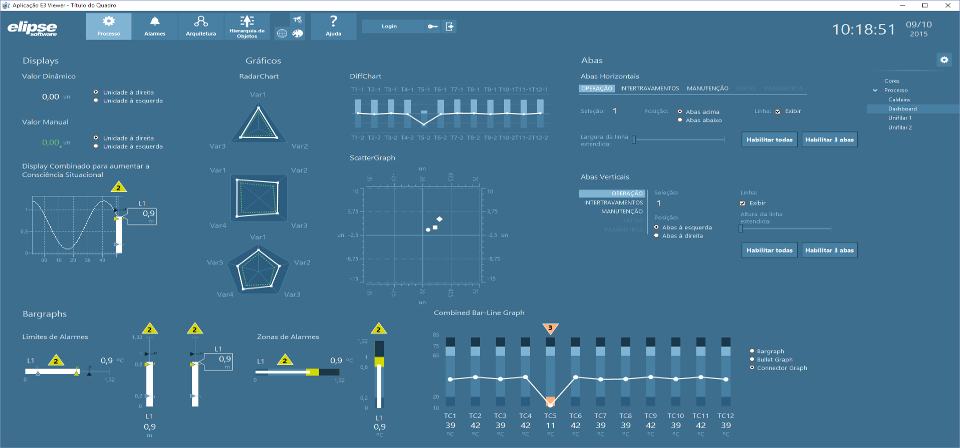

Benefits
- Connection to most devices on the market (PLCs, RTUs, and data concentrators)
- Shorter development and maintenance time, with applications standardized through libraries
- Integration with corporate and management systems
- Fast, long-lasting return on investment
- Part of an integrated monitoring and management platform that also includes power system operation (Elipse Power®) and real-time information management (Elipse Plant Manager®)
Main Features
- Multi-user and multi-project: edit and run several projects simultaneously
- Native redundancy: with synchronization of historical data and alarms
- Libraries: reusable graphic objects and data structures
- Screen editor: complete and powerful
- Remote servers: transparent native connection between them
- Data transmission: secure and compressed
- Application management: simple and intuitive
- Alarms and events: highly flexible management
- Scripting: powerful scripting tool
- Databases: native access to commercial databases
- Logs, queries, and reports: integrated tool
- Security and traceability: compliant with FDA 21 CFR Part 11
- OPC: support for OPC Classic and OPC UA
- Active Directory: integration with Windows Active Directory
Components
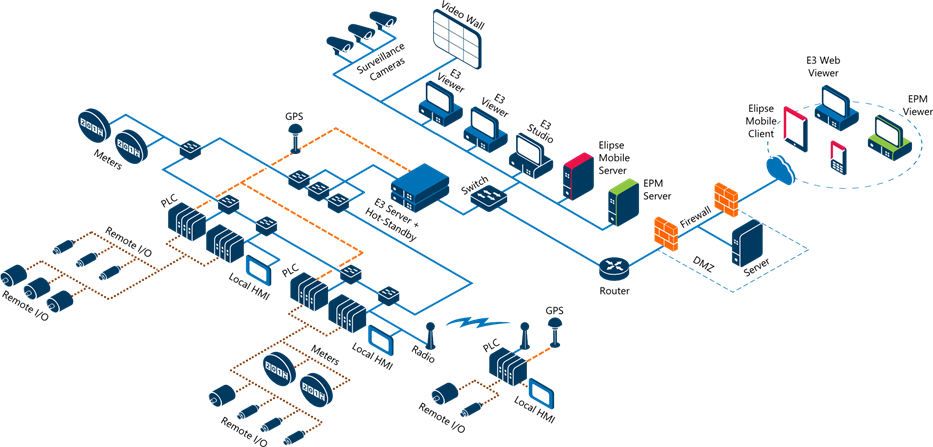
E3 Studio
A single configuration tool that works as a universal development platform. Its modern, user-friendly environment covers everything from communication setup to the script and graphics editors used to build operation screens. Several users can edit the same project at the same time, making teamwork easier.
E3 Server
The application server, which runs the system’s main processes and handles database redundancy and synchronization. Robust and reliable, it sends data and graphic information uninterruptedly to clients (Viewers), wherever they are. Available in 32-bit and 64-bit versions.
E3 Viewer
The operator interface. It lets you view and operate the server application from any computer, over the intranet or the internet, through a web browser. There is no need to install the application (project) on the client machine: all components, screens, and libraries are downloaded from the server and registered or updated automatically.
E3 Viewer comes in two versions: Viewer Control, which allows any type of operation and viewing, and Viewer Only, which is limited to viewing and queries. The number of Viewer licenses determines the number of simultaneous connections to the server.
Packages
E3 Lite
Ideal for smaller processes. Includes a single Viewer and a reduced number of I/O points.
E3 Gateway
Designed for protocol conversion, with a wide range of power industry protocols as client or server (IEC 61850, IEC 60870-5-101/103/104, DNP3, ICCP, and more), plus support for the main control devices on the market.
E3 HMI
A human-machine interface for local operation. It communicates with devices but does not store data on disk, such as alarms and historical data.
E3 Academic
Exclusively for educational institutions, this version lets students develop and simulate supervisory control projects.
Resources
Application Domain
The set of servers, projects, and libraries that make up an E3 application. The Domain defines how Viewers operate and configures native redundancy between servers. Projects and libraries can be added, removed, or edited at any time without stopping or affecting system execution, and functions can be distributed across different systems with freely segmented databases.
ElipseX Objects
ElipseX objects represent a major advance in SCADA methodology, concept, and development. With them, you can create graphic objects to reuse across screens, as well as data structures that run on servers. They can contain properties, methods, calculations, and any type of graphic symbol, including other ElipseX objects, third-party components, drivers, I/O tags, alarm definitions, and historical data. An entire application can be built from reusable components, including a licensing system for editing and execution.
Scripting
Elipse E3 features a powerful event-driven, object-oriented scripting tool for mathematical and logical operations and structure handling. You can create your own events, triggered by variable state changes or at fixed intervals. Scripts can also run inside ElipseX objects, making components more powerful and avoiding repeated code in the application.
Complete Graphic Editor
With Elipse E3, you can create any type of visualization and operation interface with superior vector graphics. Features include zoom, layer activation, movement, rotation, and irregular fills, plus a gallery of more than 3,000 ready-to-use vector symbols.
Links and Animations
Any property or object in Elipse E3 can be linked directly to any other variable or object, quickly and simply, through different types of connections. This lets you create dynamic animations and associations in a logical, intuitive way, even inside ElipseX components.
Databases and Historical Data
Elipse E3 does not use proprietary databases. All alarm, historical, formula, and other process data is stored in one or more user-defined databases, with native support for Microsoft SQL Server, PostgreSQL, MySQL, Access, and Oracle. The E3Query object lets you easily create and run any database operation, either by selecting tables, fields, filters, and sorting options with a single click or by editing the SQL command directly.
Alarms and Events
With its advanced alarms and events system, E3 lets you organize, categorize, sort, and filter messages in many different ways, making it possible to manage complex systems and control centers with hundreds of users. Functions such as suppression, shelving, and dynamic categorization, as required by standards such as ISA 18.2 and EEMUA 191, are easy to set up through hierarchical and relational links between key components such as areas, objects, and alarm sources.
E3 Playback
Replays past events in any process using the same operation screens. It shows values, animations, states, and charts from any point in the past, with controls to move forward and backward in time. This helps you understand the causes of incidents and disturbances, mark points of attention, and create shareable videos.
Additional Modules
I/O Drivers
Elipse Software offers more than 500 I/O drivers for the many protocols on the market. They connect quickly, robustly, and reliably to any device, including PLCs, DCSs, controllers, protection relays, and meters.
Remote Domains
Lets a Domain access variables from other Domains running on different servers. An application can gather data from several others, acting as an operation center, with no reconfiguration needed. This makes the process more agile and keeps the system reliable.
Complementary Products
Elipse Trend Explorer
Designed for fast, intuitive visualization and graphic analysis of historical data. Compatible with Elipse E3, Elipse Trend Explorer accesses the application database and works as a platform for displaying historical data.
Elipse Plant Manager (EPM)
Elipse E3 is natively integrated with Elipse Plant Manager (EPM), a real-time data management platform. With a powerful environment for visualization and analysis and a highly efficient collection and storage structure, EPM processes data and calculates KPIs, making it a key tool in the continuous pursuit of higher quality, lower costs, and greater operational efficiency.
Elipse Mobile
A mobile platform for SCADA integration that lets you monitor KPIs and send commands to devices. It integrates quickly and easily with Elipse E3, with no changes to the application, making the data collected by the SCADA system available on tablets and smartphones. Available for Android, iOS, Windows, and web.
Elipse Alarm Manager
A web platform integrated with Elipse E3 for managing the alarm and event lifecycle. It lets you track changes, create scenarios, and identify and analyze the causes of disturbances and alarm floods, improving operational safety and quality.
Elipse E3 success stories
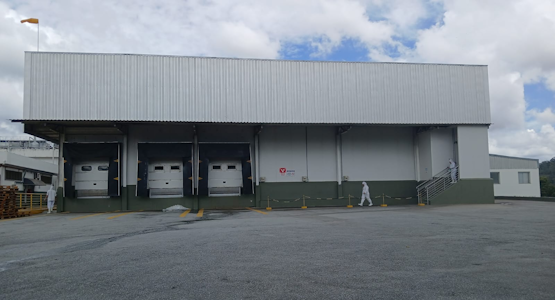 Adeel Alimentos increase quality, predictability in their pork-based production line with Elipse E3
Platform by Elipse Software helps control with more accuracy the temperatures and cooking/smoking times in the process, so products leave the factory on point for commercialization
Read more →
Adeel Alimentos increase quality, predictability in their pork-based production line with Elipse E3
Platform by Elipse Software helps control with more accuracy the temperatures and cooking/smoking times in the process, so products leave the factory on point for commercialization
Read more →
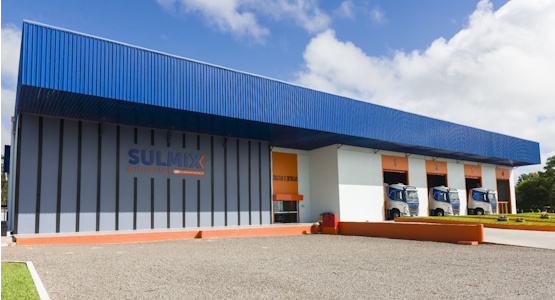 Elipse E3 and ERP interact in application at Sulmix to control production and formulas more efficiently
With the platform by Elipse Software, Sulmix can ensure clients that their orders will be delivered according to the best practices in the market and following inspection agencies’ standards
Read more →
Elipse E3 and ERP interact in application at Sulmix to control production and formulas more efficiently
With the platform by Elipse Software, Sulmix can ensure clients that their orders will be delivered according to the best practices in the market and following inspection agencies’ standards
Read more →
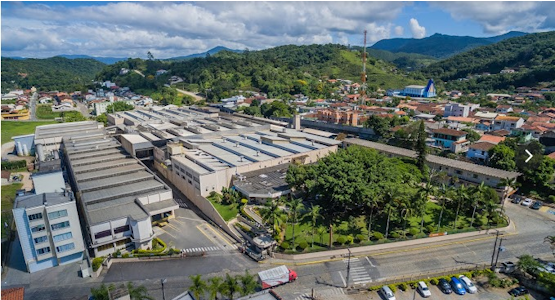 Elipse Plant Manager and Elipse E3 facilitate preventive maintenance at ZEN S.A. for a more efficient production
Elipse Software’s platforms monitor different pieces of equipment at automotive manufacturer ZEN S.A., stave off high maintenance costs of up to U$ 15 thousand per month
Read more →
Elipse Plant Manager and Elipse E3 facilitate preventive maintenance at ZEN S.A. for a more efficient production
Elipse Software’s platforms monitor different pieces of equipment at automotive manufacturer ZEN S.A., stave off high maintenance costs of up to U$ 15 thousand per month
Read more →
 Elipse E3 controls 90% of variables at Fiocruz research center, complying with FDA’s CFR21 Part 11 Standard
Elipse Software’s SCADA platform is used in the automation of different systems in the Research Center, regarded as the golden standard in the Brazilian health surveillance sector
Read more →
Elipse E3 controls 90% of variables at Fiocruz research center, complying with FDA’s CFR21 Part 11 Standard
Elipse Software’s SCADA platform is used in the automation of different systems in the Research Center, regarded as the golden standard in the Brazilian health surveillance sector
Read more →
Related news
 Elipse Software celebrates 40 years of history
01/10/2026
Four decades after being founded by five young workmates in Porto Alegre, Brazil, the company has become a leading name in SCADA software worldwide
Elipse Software celebrates 40 years of history
01/10/2026
Four decades after being founded by five young workmates in Porto Alegre, Brazil, the company has become a leading name in SCADA software worldwide
 Elipse Drivers 12 – August/2026
19/08/2026
Check out the latest developments for Elipse drivers
Elipse Drivers 12 – August/2026
19/08/2026
Check out the latest developments for Elipse drivers
 Elipse Plant Manager version 7.0: more autonomy for assets management
26/05/2026
The platform by Elipse Software was updated to improve process monitoring, thus optimizing the generation of indicators and real-time data analysis
Elipse Plant Manager version 7.0: more autonomy for assets management
26/05/2026
The platform by Elipse Software was updated to improve process monitoring, thus optimizing the generation of indicators and real-time data analysis
 Elipse Drivers 11 – May/2026
15/05/2026
Check out the latest developments for Elipse drivers
Elipse Drivers 11 – May/2026
15/05/2026
Check out the latest developments for Elipse drivers
