
Elipse Alarm Manager
The boom in connected devices and the growing volume of information that needs real-time monitoring have an unfortunate side effect: more and more alarms are being created in supervisory systems. This overwhelms operators and increases the likelihood of accidents and of physical, financial, and environmental risks.
The Current Scenario
Alarm management problems are common in plants and control rooms. Their main causes are:
- Alarms created indiscriminately in SCADA systems, without any corporate policy
- Operators overloaded with alarms whose urgency levels are hard to tell apart
- Many operators handling more than 1,200 alarms per day
Used to their full potential, alarms should help operators detect and correct process failures, not simply flag isolated variables.
Alarm Floods
Alarm floods can have many causes, such as:
- Too many alarms added to the system
- Changes to processes and equipment
- Poorly designed alarms
- Obsolete or degraded equipment
- Temporary process changes, such as unplanned downtime
- Alarm design and management often left out of work processes or system administration
Why Alarm Management Matters
Alarm management makes it faster and easier to:
- Improve operator working conditions and workload
- Increase system reliability
- Ensure better environmental and safety conditions
- Prevent unplanned stops or interruptions
- Promote operational efficiency and stability and maximize financial return
Elipse Alarm Manager (ELAM)
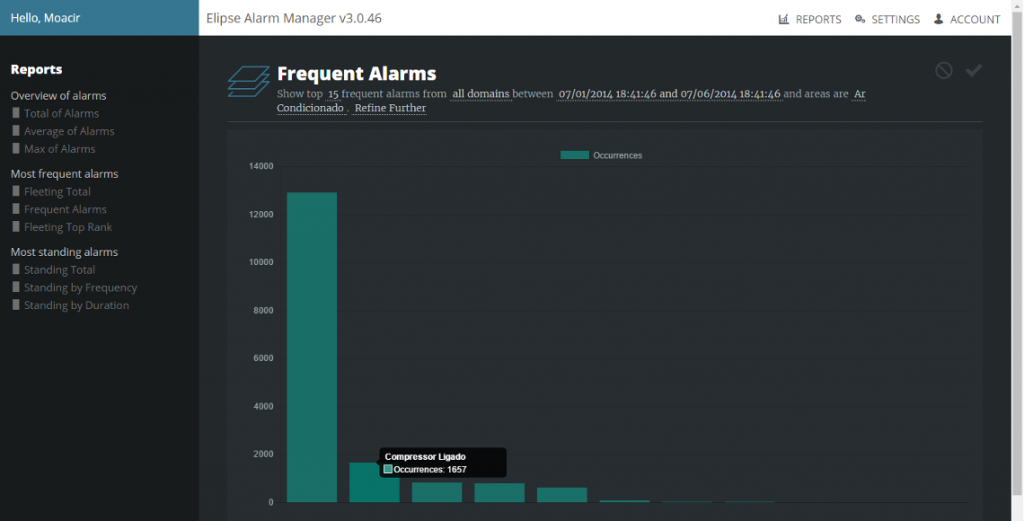
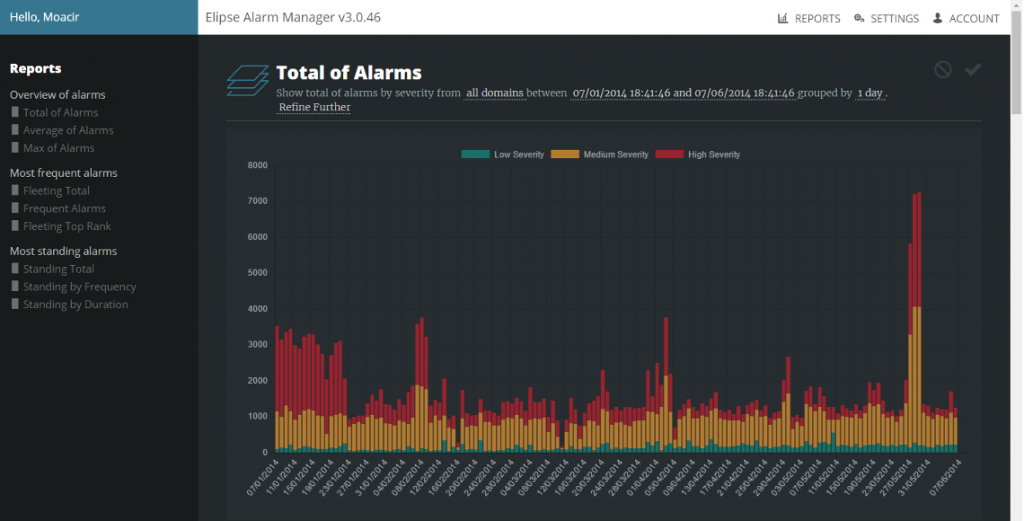
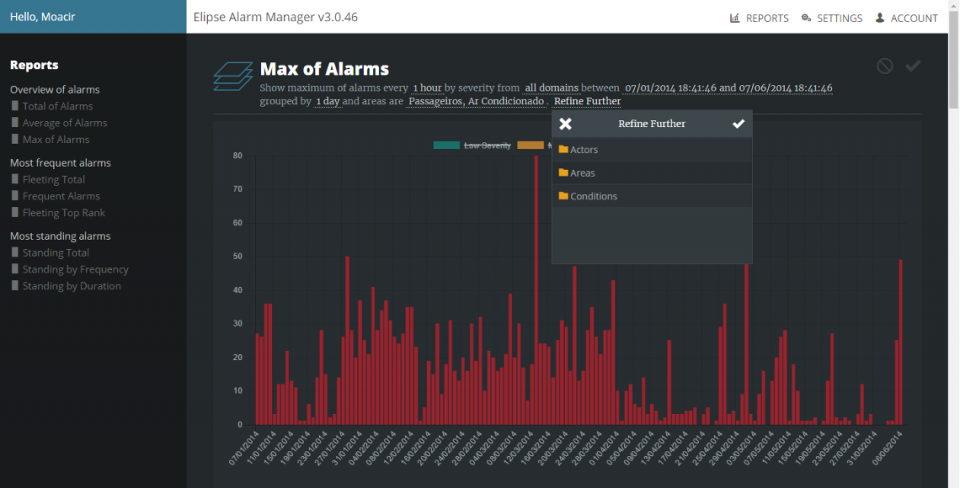
Fully based on the ISA-18.2 and IEC 62682 standards, Elipse Alarm Manager (ELAM) is a platform that supports data mining and analysis across the alarm lifecycle to optimize system behavior. Its reporting tool analyzes key performance indicators over time, showing whether operators face alarm overload and identifying alarms that occur frequently, stay active for long periods, or need extended attention.
These analyses help identify faulty or poorly configured devices that need adjustment after process changes.
Elipse Alarm Manager consists of three programs: Collector, Server, and Client.
ELAM Collector is usually installed on the same computer or network as the SQL Server database that stores Elipse E3 or Elipse Power alarms. It reads the data in this database and sends it to ELAM Server through firewalls.
ELAM Server processes the alarms sent by the Collector, normalizes them, and saves them to a data warehouse, a database designed specifically for reporting. It also provides a REST API that generates reports in JSON format through HTTP requests. This lets ELAM integrate with other systems and reporting tools, such as Microsoft Power BI® and SQL Server Reporting Services® (SSRS). The Client uses the same services, displaying all Server reports and resources in a user-friendly, efficient, cross-platform interface.
ELAM Client is a responsive web application compatible with all major browsers, such as Google Chrome®, Microsoft Edge®, and Mozilla Firefox®. With it, you can access all Server reports from anywhere and on many devices, including tablets, desktops, laptops, smartphones, and smart TVs.
Faster Analysis, Anytime, Anywhere
The latest version of Elipse Alarm Manager was completely redesigned to run in all major browsers and fit every screen size, from smartphones to smart TVs. Its modern, high-performance interface generates reports up to ten times faster, creating a more productive environment for analysts.
The new data warehouse keeps data normalized, which speeds up report generation. Once the Collector is installed, the Collector and Server work side by side to mine data and optimize reports, making your analyses more efficient.
With the new ELAM search criteria tool, you can browse multiple Elipse domains at once in a concise interface designed to keep you focused on the information that matters for your process.
Related news
 Elipse Software celebrates 40 years of history
01/10/2026
Four decades after being founded by five young workmates in Porto Alegre, Brazil, the company has become a leading name in SCADA software worldwide
Elipse Software celebrates 40 years of history
01/10/2026
Four decades after being founded by five young workmates in Porto Alegre, Brazil, the company has become a leading name in SCADA software worldwide
 Elipse Drivers 12 – August/2026
19/08/2026
Check out the latest developments for Elipse drivers
Elipse Drivers 12 – August/2026
19/08/2026
Check out the latest developments for Elipse drivers
 Elipse Plant Manager version 7.0: more autonomy for assets management
26/05/2026
The platform by Elipse Software was updated to improve process monitoring, thus optimizing the generation of indicators and real-time data analysis
Elipse Plant Manager version 7.0: more autonomy for assets management
26/05/2026
The platform by Elipse Software was updated to improve process monitoring, thus optimizing the generation of indicators and real-time data analysis
 Elipse Drivers 11 – May/2026
15/05/2026
Check out the latest developments for Elipse drivers
Elipse Drivers 11 – May/2026
15/05/2026
Check out the latest developments for Elipse drivers
