São Lourenço Production System (SPSL) makes faster, better-informed decisions with Elipse Plant Manager
Elipse Software’s platform graphically analyzes the equipment and variables of the São Lourenço Production System, which is responsible for water intake and treatment in Vargem Grande Paulista (SP)
Published on 03/24/2026
Needs
São Lourenço Production System Inc. (SPSL S.A., its acronym in Portuguese) is a special purpose entity (SPE) established in 2013 to carry out a public-private partnership (PPP) providing operation and maintenance services for the system that dewaters, dries, and disposes of the sludge generated at its Water Treatment Plant (WTP). Additionally, SPSL is responsible for the maintenance of the São Lourenço Production System and for construction works on the project, which belongs to the Basic Sanitation Company of the State of São Paulo (SABESP, its acronym in Portuguese).
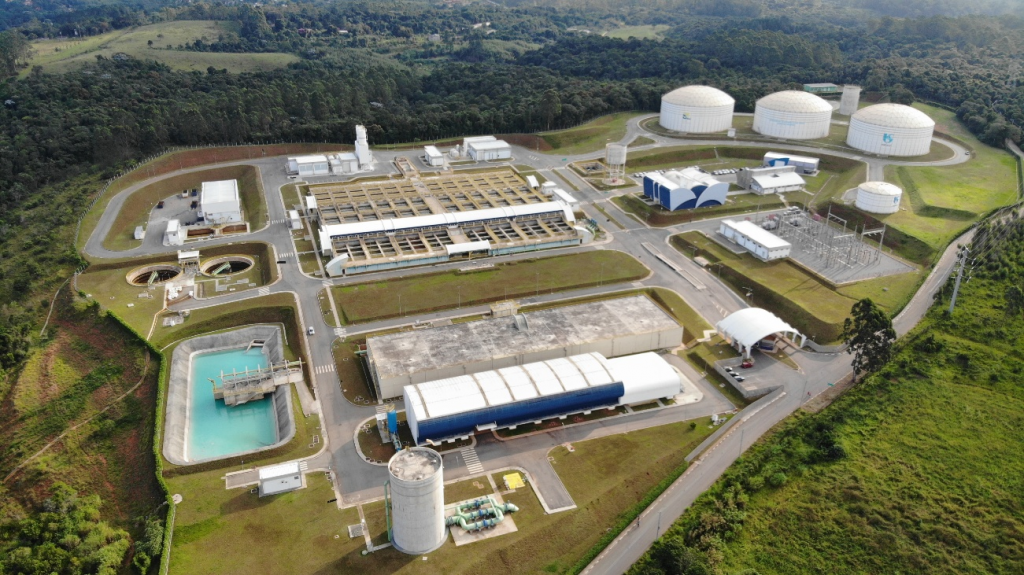
The São Lourenço Production System carries water from the Cachoeira do França Dam in Ibiúna (SP) to the Vargem Grande Paulista WTP (SP), traveling 83 km through pipelines to the municipalities it serves. Construction began in 2014; trial operation started in April 2018, and full commercial operation in July of the same year.
The system is interconnected with the other systems that supply the São Paulo Metropolitan Area. It sustainably increased treated water production capacity in the region and brought several benefits to the population, including:
- Continuous, sustainable, high-quality water supply with excellent operational efficiency.
- Meeting the estimated demand of the São Paulo Metropolitan Area.
- Capacity to meet future demand in the western region of the Metropolitan Area.
In its search for a technology to collect, analyze, and store data on the water intake and treatment processes carried out by the São Lourenço Production System, SPSL has opted for Elipse Plant Manager (EPM). The platform by Elipse Software, Brazil’s leader in remote process management solutions, ensures high performance in recording and querying data, as well as greater availability and usability of information. Notably, SPSL’s own automation team implemented and customized this EPM application.
Solution
EPM manages and analyzes the processes using variables from the equipment at the Raw Water Intake (RWI) and the WTP. The system’s WTP and RWI automation architecture comprises 79 programmable logic controllers (PLCs) from different manufacturers, 1,235 field devices, and one SCADA system, all interconnected by an industrial network. With EPM, SPSL can monitor processes in real time via trend charts, notifications, dashboards, and comparative panels.
With EPM, it is also possible to track the behavior of system variables such as flow, level, pressure, temperature, vibration, electrical quantities, and analytical parameters (pH, color, chlorine, water turbidity). The resulting information enables accurate analyses and helps the SPSL team make better-informed decisions that optimize the system’s operation and maintenance, allowing a more preventive and less corrective approach.
Among the processes, devices, and variables monitored by EPM in this application, we highlight the following:
Motor-pump set monitoring
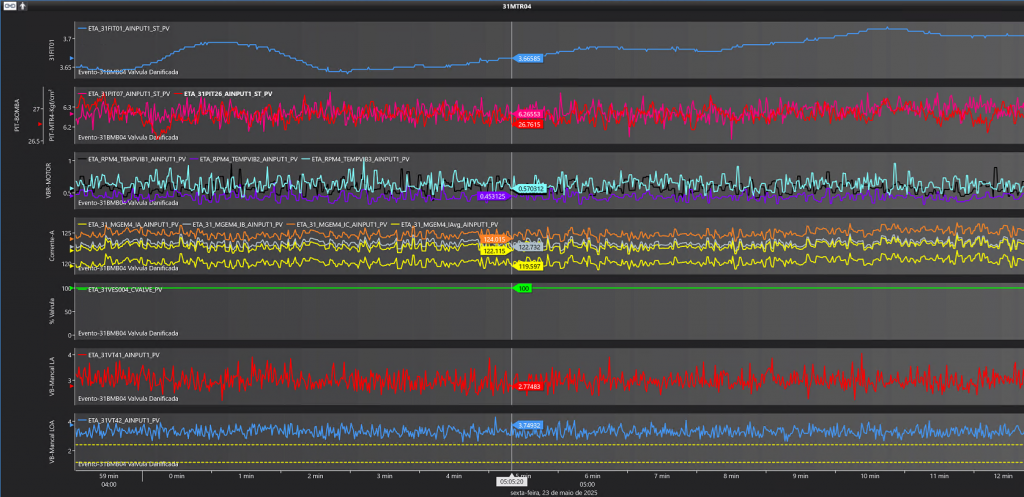
EPM monitors the equipment that pumps finished water from the WTP to the system’s external reservoirs. To do so, the platform by Elipse Software features a chart that trends main line flow, discharge line flow, overall discharge pressure, discharge valve opening (%), and motor current and vibration, as well as vibration at the pump’s drive and non-drive ends.
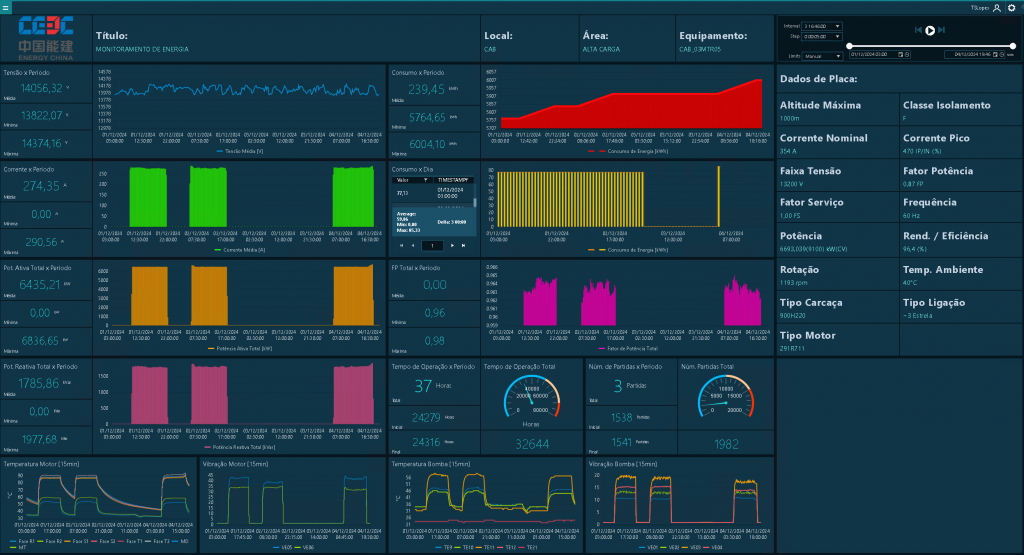
With EPM Portal, the platform also analyzes and monitors the main operating parameters (current, power, power factor, energy consumption, operating time, number of starts, temperature, motor vibration) of the five highest-power pump motors at the RWI. By comparing these variables’ real-time data to the rated values on the motors’ nameplates, the software makes it possible to evaluate the performance of each variable and the service life of the equipment.
Filter backwashing
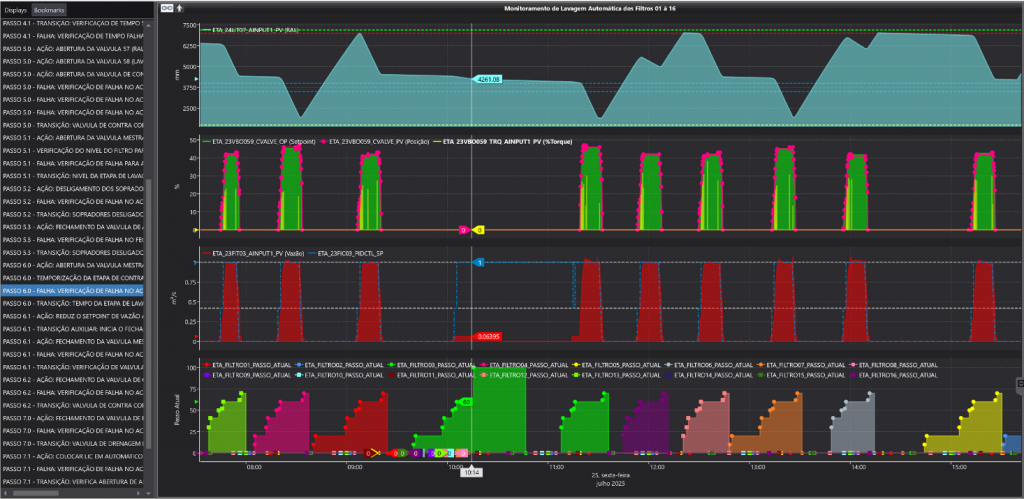
EPM has streamlined the handling of filter backwashing failures at SPSL. Before this project, whenever a failure occurred, the maintenance team had to go on site, reset the backwash, connect to the PLC, and program a new backwash cycle so they could analyze the PLC logic to find the step of the process where the failure had occurred. Now, thanks to EPM, when a filter has a problem, the maintenance team can identify where and why it failed more quickly, eliminating the need for direct access to the filters’ PLCs and significantly reducing response time.
Sludge removal
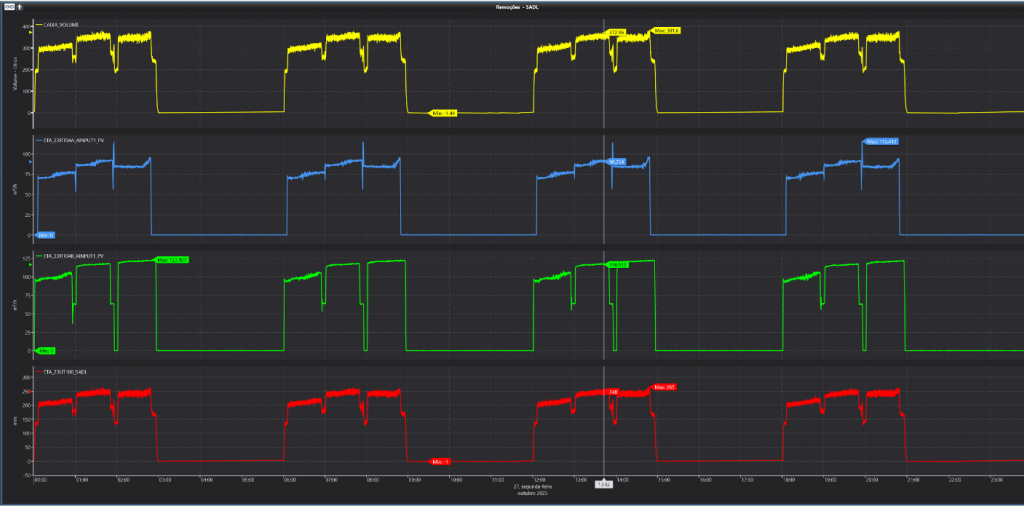
EPM can plot the variables of the process responsible for sludge removal in water treatment, comparing and relating the level (mm) to the volume (L) in the settling tanks’ discharge chamber. These analyses, provided by the Elipse platform, allow SPSL to determine the maximum number of sludge removal cycles that can be programmed without causing overloads or other damage to the system.
Master valve
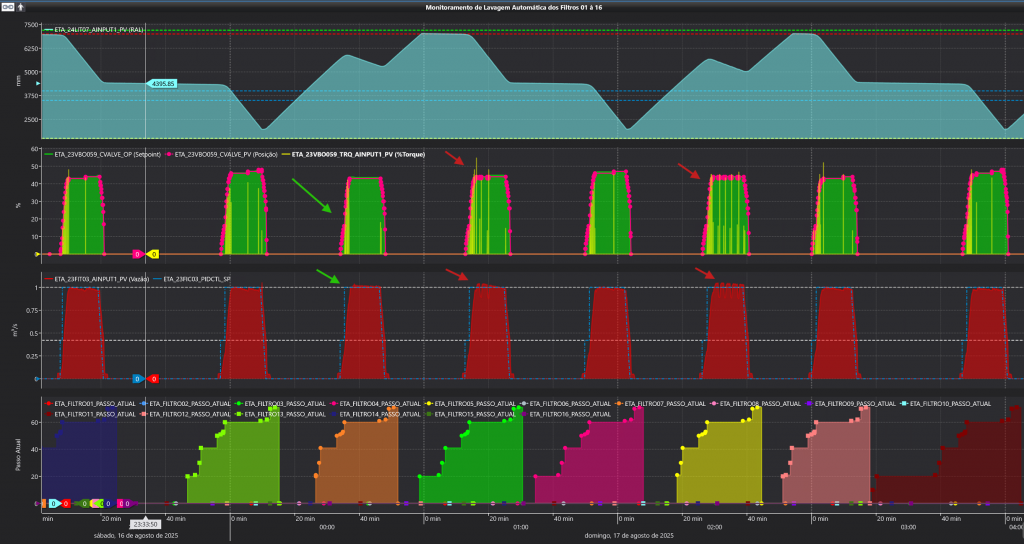
EPM has also delivered good results in analyzing failure events in the main flow control valve used for filter backwashing.
Benefits
According to SPSL’s automation team, who implemented the application in-house, EPM ensures faster process analysis and decision-making and is an essential tool for maintenance.
“With EPM, we can speed up analysis and make better-informed decisions, acting more efficiently to prevent and resolve failures that occasionally arise at the São Lourenço Production System,” says Anderson Pereira dos Santos, SPSL’s Automation and Instrumentation Coordinator.
“Some issues could take a long time to spot if we relied only on the SCADA system. EPM now gives us much more comprehensive, granular control of the processes,” adds his teammate Tiago de Souza Lopes, SPSL’s Automation Technician.
Among the benefits the Elipse platform has brought to SPSL, we highlight the following:
- Faster root cause analysis.
- More reliable real-time information.
- The ability to analyze process data and events across multiple time intervals via historical trend charts with second-by-second logging.
- A more comprehensive, granular view of all processes, equipment, and variables important to the operation of the São Lourenço Production System.
- Greater cost savings, since it enables a more preventive and less corrective approach.
Datasheet
- Client
- São Lourenço Production System Inc. (SPSL)
- Solution provider
- São Lourenço Production System Inc. (SPSL)
- Elipse product
- Elipse Plant Manager 6.00.161
- Platforms
- Windows 10 and Windows Server 2016
- Number of copies
- 2
- Number of I/O points
- 50,000
- Drivers
- OPC and SNMP II
- Industry
- Water and Wastewater
