
Energimp takes control of 242 wind turbines by insourcing its SCADA with Elipse Power
With the insourcing, Energimp S.A. now controls its five wind complexes through Elipse Software’s platform and its own operation center, no longer depending on the previous SCADA system
Published on 10/06/2026

Needs
Energimp S.A. is a Brazilian wind power generation company that operates five wind complexes, comprising 15 wind farms and 242 wind turbines, with a total installed capacity of 363 MW. Three of these complexes are in the state of Ceará, in northeastern Brazil, in the municipalities of Acaraú, Itarema, and Aracati, and the remaining two are in the state of Santa Catarina, in southern Brazil, in the municipalities of Água Doce and Bom Jardim da Serra. The company’s operations infrastructure includes a main Generation Operation Center (GOC) and a backup operation center, both of which are responsible for supervising and operating the generation assets.
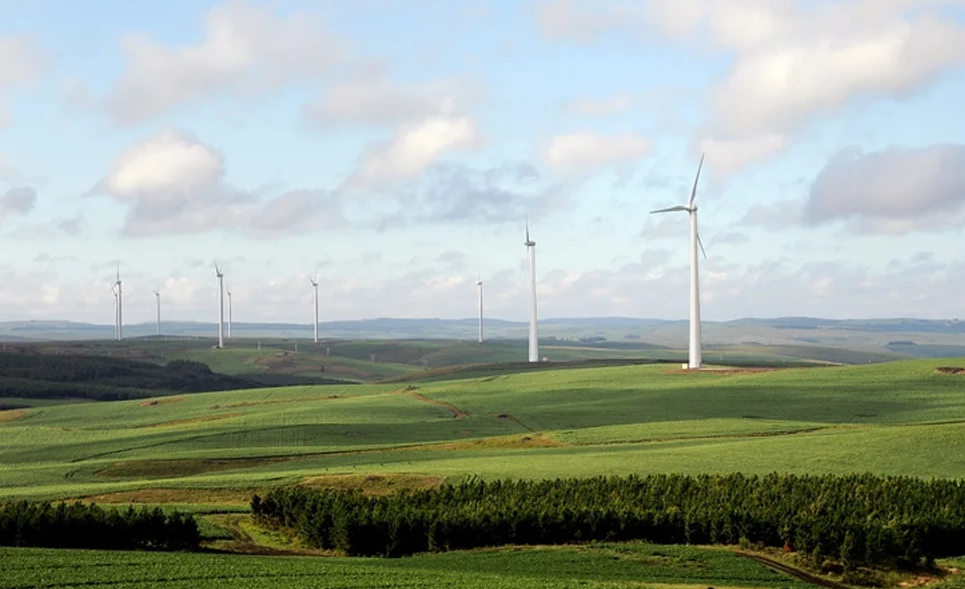
When a wind turbine is purchased, operation and maintenance (O&M) usually comes with the deal, including field technicians, a maintenance plan, and the manufacturer’s own SCADA system. Throughout the years of wind power expansion in Brazil, the sector has remained highly dependent on these suppliers. To change this situation, Energimp started operating its turbines like any other generation source, taking control of their software, hardware, and parts replacement. Software, one of these fronts, is the focus of this project.
Before the insourcing project, all control of Energimp’s wind farms was handled by the turbine manufacturer. Energimp’s existing Elipse Power, an Elipse Software platform, communicated with the manufacturer’s SCADA via the Modbus protocol. This setup only allowed it to monitor operational statuses and electrical quantities, with no way to act on the equipment.
In addition to this functional limitation, communication had low reliability, requiring frequent reboots of the manufacturer’s servers. These issues compromised information availability and increased operational response time. Any adjustments, such as adding points or editing screens, depended on the manufacturer, whose software served thousands of turbines around the world and therefore could not be customized to meet a single customer’s needs.
Energimp launched a project to insource its SCADA system, aiming to achieve operational autonomy, improve the reliability of supervision, and gain direct control of its wind turbines. The project’s main challenge was to develop a new communication architecture that would allow Elipse Power to connect directly to the turbines’ Beckhoff TwinCAT controllers, thus eliminating the dependence on the SCADA system supplied by the manufacturer.
Solution
To carry out the new project and gain greater control autonomy, Energimp had the support of Sustavi Scada & Automation, which conducted an extensive reverse engineering effort. This highly complex task involved analyzing the data structures, studying the controllers, defining the communication architecture, and validating the most suitable protocols to ensure the security, performance, and reliability of operations.
Since there was no direct access to the manufacturer’s SCADA, Sustavi reversed the usual approach. Instead of working down from the top layer of the system, the team started at the base of the turbine, identifying all the points and communication methods available on the controllers, and only then building the new architecture from the bottom up.
After the architecture was validated, a new point list was designed based on the information gathered during the analysis stage. The entire variable mapping was reorganized, allowing significantly more comprehensive supervision of the wind turbines. Elipse Power now communicates directly with the turbines’ TwinCAT PLCs over the N2 network, and the data is then distributed to Energimp’s GOC using the IEC 60870-5-104 protocol.
It took about a year to complete the development of this new project. In January 2025, Energimp shut down the manufacturer’s SCADA and started operating its turbines entirely with Elipse Power. With the new architecture in place, the GOC took full control of all 242 wind turbines directly from the Elipse platform.
Elipse Power thus went from a simple monitoring system to one capable of executing several operational commands, such as starting and stopping the turbines and limiting their power output, in addition to real-time monitoring and alarm management. To support these functions, the platform now features new screens.
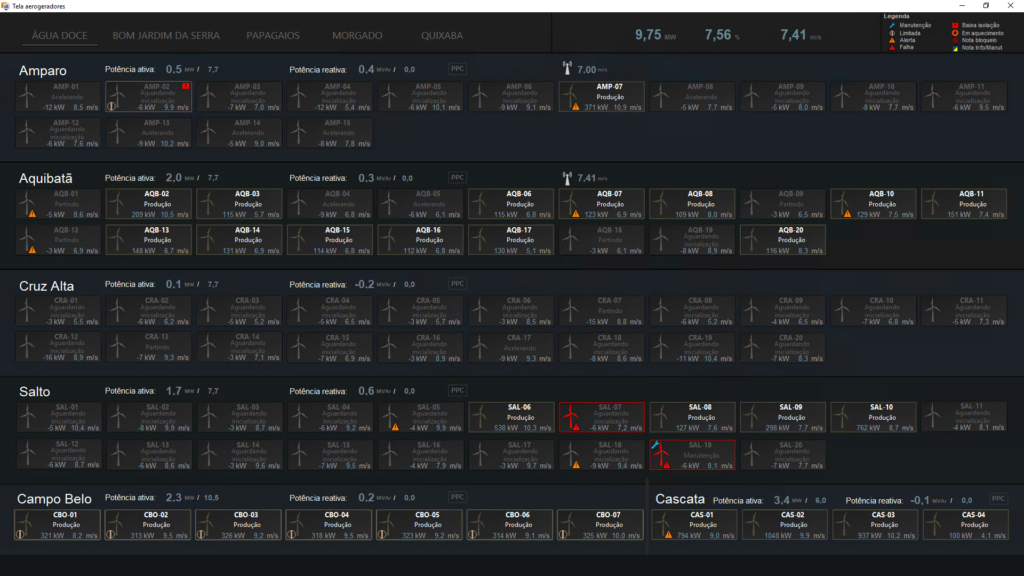
The main screen, which is always open, brings together all five of Energimp’s wind complexes. Each square on this screen represents a wind turbine, showing its status, power output, wind speed, and whether it is generating or under maintenance, with a legend for power limitation, warning, fault, lockout, and low insulation resistance.
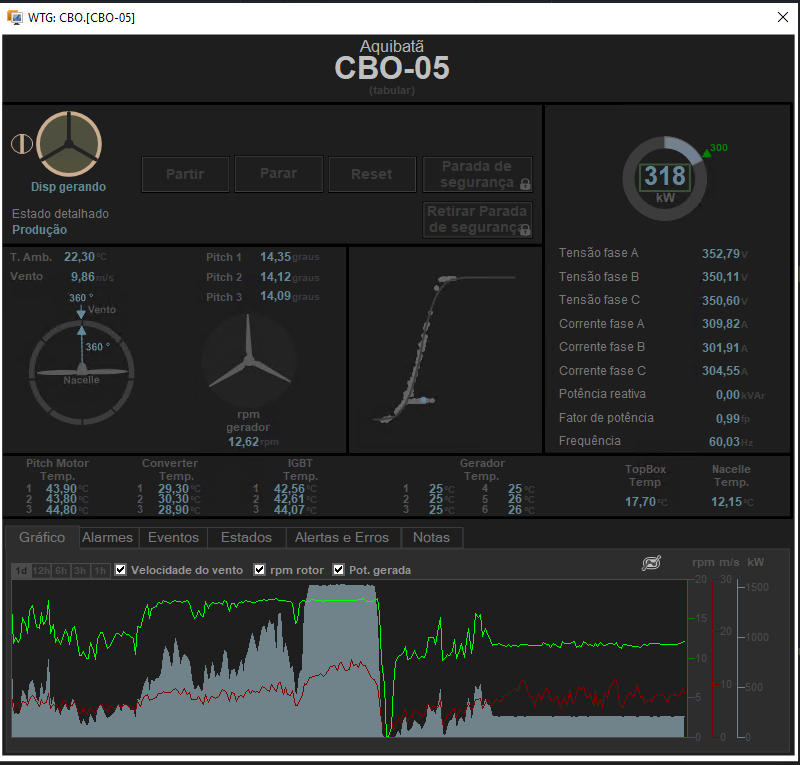
Clicking a square takes operators from the wind complex screen to the turbine control screen, where they can access the turbine’s analog measurements, digital points, power curve, wind speed, rotor speed, alarms, errors, events, notes, and a generation chart for its last 24 hours of operation. The result is complete control, from a macro view of the complex and its wind farms down to a micro view of each individual turbine.
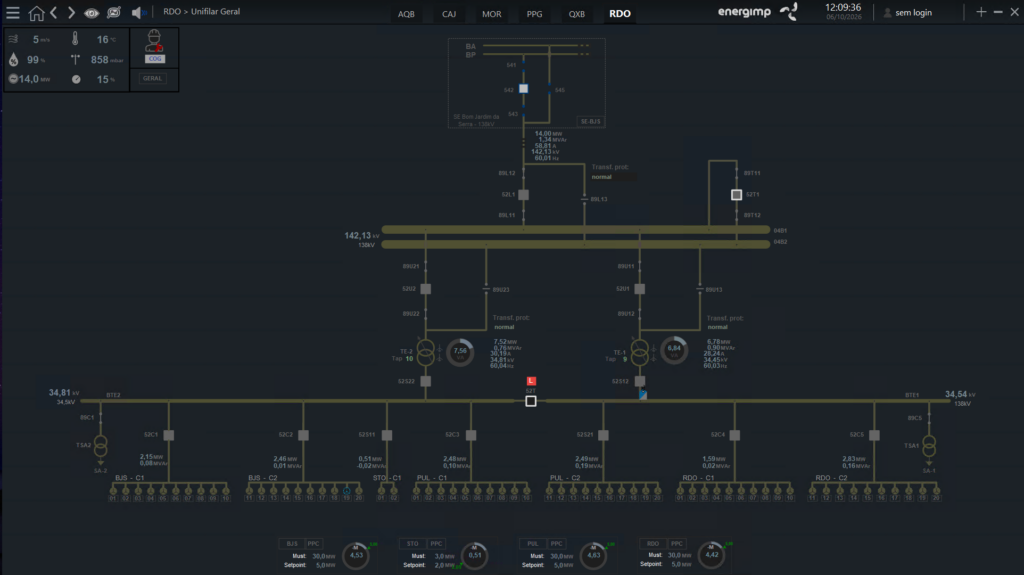
Elipse Power also allows operators to monitor each complex’s single-line diagram, showing its connection to the substation and busbars, all the way down to the transformers, reclosers, and circuits. The new screens have also made it easier for operators to control the wind farms’ active power. In addition to the manufacturer’s original PPC (Power Plant Controller), which is responsible for applying generation limits to the wind turbines, such as curtailment requested by the ONS (Brazil’s National Electric System Operator), the operations team can rely on a fallback function developed by Sustavi in Elipse Power.
This function, configured to act as a PPC for active power control in specific situations or when the main controller is unavailable, allows automated distribution of commands across all 242 wind turbines. With one dedicated screen per wind farm, operators set the desired value, and then the system distributes the power equally among the turbines in that farm, with no need for individual commands. The solution also supports maintenance and other operational interventions, increasing operational flexibility and reducing response time in contingency situations.
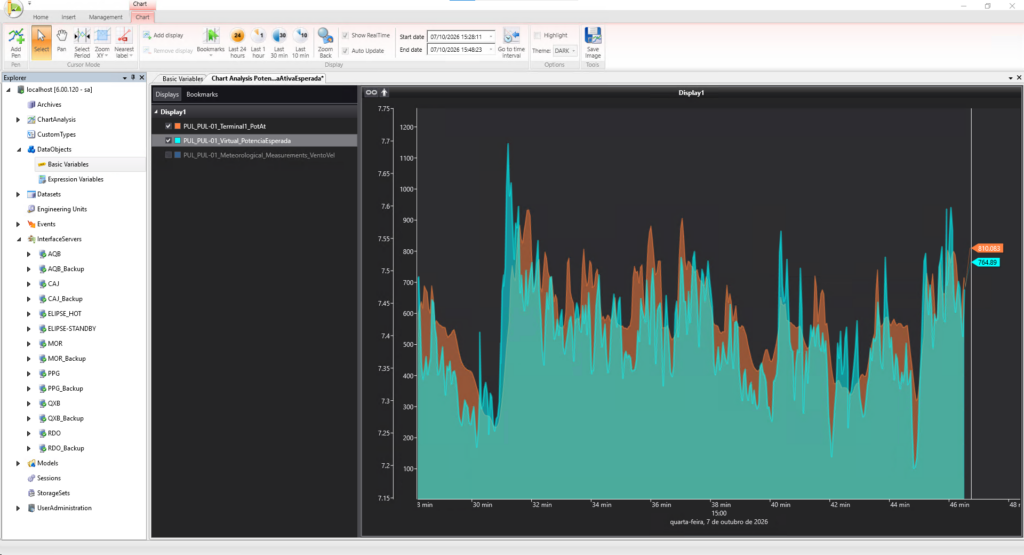
To complement the solution, Elipse Plant Manager (EPM) was also deployed with a database to provide historical storage of process variables. The Elipse platform was already in use at Energimp, but with a very limited dataset. With the new data acquisition, the number of points controlled per wind turbine went from about 30–40 to almost 300. Centralizing the historical data made it possible to integrate with Energimp’s data team, who now uses this information to compile performance indicators, perform operational analyses, and drive initiatives to optimize power generation.
In addition to the SCADA system, the project included EGPWEB, an application developed for the operation and maintenance (O&M) teams. The initial idea was to allow field technicians to check the wind turbines’ statuses and alarms. Once integrated with EPM, this responsive web application also began providing reports, real-time information, access to operational history, and tools to support diagnostics in the field, allowing quick queries via computers, tablets, mobile devices, and web browsers.
The application also isolates access: data is available to users without giving them access to Energimp’s operation network, meeting security requirements and complying with the ONS’s operating procedures. EGPWEB’s backend uses Python and C++, along with E3DataAccess (Elipse) to access real-time information from Elipse Power and an OPC UA client to communicate with EPM. The frontend was developed with JavaScript, HTML5, and CSS3.
Sustavi was the company responsible for developing the entire insourcing solution, covering everything from studying the communication architecture and carrying out the reverse engineering to developing the screens and applications for Elipse Power, EPM, and EGPWEB. The project resulted in a modern, robust, and scalable platform, allowing Energimp to take full control of its wind power generation assets with greater operational reliability, autonomy, and availability of real-time information.
Benefits
The implementation of the new automation architecture based on Elipse Power and EPM has brought several operational gains to Energimp. According to Victor Brito, engineering manager at the company, the main one is autonomy.
“Today, when I install a sensor, I have the freedom to create an extra point in the SCADA and develop a monitoring screen. I have the autonomy that comes with our own system, and I can tailor it in the best way possible to deliver maximum value to our operations team,” he says.
Key benefits the new system has brought to Energimp include:
- Complete operational autonomy, allowing Energimp’s GOC to take full control of all 242 wind turbines, thus eliminating the dependence on the SCADA system supplied by the manufacturer.
- Freedom to evolve the system: new sensors, points, and screens can be added without depending on the manufacturer’s authorization.
- Significant decrease in operational response time, allowing the GOC to directly execute return-to-operation commands and interventions on the wind turbines.
- Higher communication reliability, eliminating the recurring unavailability that affected the previous architecture and required frequent reboots of the manufacturer’s servers.
- The new point list now provides significantly more process variables, operational statuses, alarms, and diagnostic information, going from about 30–40 points to almost 300 per wind turbine.
- Centralized operational history through EPM, allowing Energimp’s data team to use historical data to analyze performance, develop indicators, and support decision-making.
- Greater efficiency for operation and maintenance teams through the EGPWEB application, which provides real-time information and operational history directly on mobile devices, reducing the time needed for diagnostics and field interventions without exposing the operation network.
- Optimized operation of the wind farms with dedicated Elipse Power screens for operating the turbines as a group, which serve as a fallback for the PPC and make operators’ work easier in contingency situations and when the PPC is unavailable.
Datasheet
- Client
- Energimp S.A.
- Solution provider
- Sustavi Scada & Automation
- Elipse products
- Elipse Power and Elipse Plant Manager
- Platform
- Microsoft Windows Server
- Number of copies
- 8 (6 Elipse Power Renewable + 1 Elipse Power EMS + 1 EPM Server Lite)
- Number of I/O points
- 150,000
- Drivers
- TwinCAT and IEC 60870-5-104
- Industry
- Wind power generation
